
How Much Does a Quality Couch Actually Cost? A Realistic Price Guide

Couch Value & Lifespan Calculator
Annual Cost Analysis
Based on this price and lifespan, this couch is a Mid-Range value choice.
Value Comparison Guide
Price: $500 - $1,200
Life: 2-5 Years
Risk: Higher annual replacement cost.
Price: $1,500 - $3,500
Life: 7-15 Years
Value: The "Sweet Spot" for most users.
Price: $4,000+
Life: 20+ Years
Value: Heirloom quality, lowest long-term cost.
You've spent hours scrolling through Pinterest and Instagram, and now you're ready to buy. But the moment you look at price tags, you're hit with a confusing range. One store sells a "luxury" sofa for $600, while another wants $4,000 for something that looks almost identical. Why the massive gap? The truth is, the average price of a good quality couch isn't a single number-it's a range based on how long you actually want the piece to last. If you buy a cheap one, you're essentially paying a subscription fee to replace it every three years.
Quick Budget Breakdown
- Budget/Entry-Level: $500 - $1,200 (Lasts 2-5 years)
- Mid-Range/Quality: $1,500 - $3,500 (Lasts 7-15 years)
- High-End/Investment: $4,000 - $10,000+ (Lasts 20+ years)
What Exactly Is a "Good Quality" Couch?
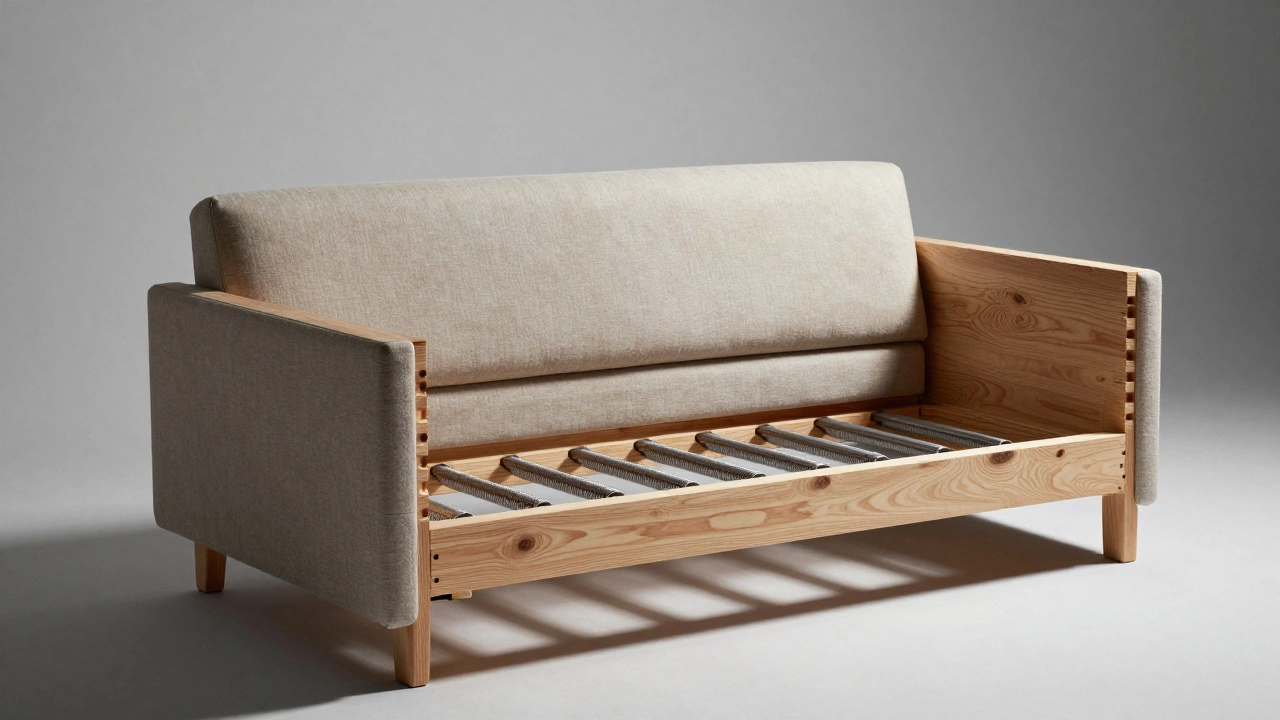
Before we talk numbers, we need to define quality. In the furniture world, quality isn't about the brand name or the fancy showroom; it's about the guts. Kiln-Dried Hardwood is a process where wood is dried in an oven to remove moisture, preventing the frame from warping or cracking over time. If a couch uses particle board or plastic, it's not a quality piece, regardless of the price.
Then there's the suspension. A high-quality sofa usually features Eight-Way Hand-Tied Springs, which are springs tied by hand in eight different directions to ensure the seat doesn't sag after a few months of sitting. If you see "sinuous springs" (those zigzag wires), you're in the mid-range. They're fine, but they won't give you that "like-new" feel for a decade.
The Mid-Range Sweet Spot: $1,500 to $3,500
For most people, this is where the real value lives. When you spend in this bracket, you stop paying for disposable furniture and start paying for materials. At this price, you can expect a frame made of solid wood and upholstery that can actually handle a spilled drink or a shedding dog.
A major factor here is the Fabric Grade. You'll find that Performance Fabrics-like those treated with moisture-repellent coatings-often push the price toward the $3,000 mark. These materials are essential if you have kids or pets. If you opt for a basic polyester blend, you might stay closer to $1,800, but you'll trade off some of that lifelong durability.
| Feature | Budget ($500 - $1k) | Mid-Range ($1.5k - $3.5k) | Investment ($4k+) |
|---|---|---|---|
| Frame Material | Particle Board/Plywood | Kiln-Dried Hardwood | Solid Oak/Maple |
| Cushion Core | Low-Density Foam | High-Resiliency (HR) Foam | Down-Wrapped Foam |
| Joints | Staples & Glue | Double-Doweled/Screwed | Mortise and Tenon |
| Lifespan | 2-4 Years | 7-12 Years | 20+ Years |
The Luxury Tier: When to Spend $4,000 or More
Is a $6,000 sofa actually three times better than a $2,000 one? In terms of raw comfort, maybe not. But in terms of craftsmanship, yes. At this level, you're often looking at Top-Grain Leather, which is the highest quality layer of the hide, which develops a patina over time rather than peeling like faux leather.
You're also paying for customization. High-end brands let you choose the exact depth of the seat, the firmness of the cushions, and the specific weave of the fabric. This is a "buy it once" purchase. If the frame is joined with mortise-and-tenon joints (where one piece of wood fits perfectly into a hole in another), that couch will likely outlive the house you put it in.
Hidden Costs That Inflate the Price
Sometimes a couch is expensive not because of the quality, but because of the brand's overhead. A sofa from a high-end boutique in a fancy mall might cost $3,000, while a similar one from a direct-to-consumer brand costs $1,800. The difference is often just the rent the store has to pay.
Another sneaky cost is shipping and delivery. Heavy, quality furniture costs a lot to move. If you're buying a solid hardwood frame, expect to pay $100 to $300 for "white glove" delivery-where they carry it into your room and take away the packaging. If you try to save money by shipping it yourself and drop it on the curb, you've just spent a lot of money on a very expensive piece of sidewalk art.
How to Spot a "Fake" Quality Couch
Salespeople love to use the word "quality," but you have to verify it. Here are a few quick tests you can do in the store:
- The Squeeze Test: Grip the arm of the couch and squeeze. If it feels hollow or creaks, it's likely made of cheap plywood or staples. A quality couch feels like a solid block of wood.
- The Bounce Test: Sit down firmly. If the whole frame lifts off the ground or shifts, the base is weak.
- The Rub Test: Look for the "Martindale rating" on the fabric tag. This measures abrasion resistance. For a daily-use family couch, you want a rating of at least 30,000 rubs. Anything under 15,000 will look worn out within two years.

Choosing Based on Your Lifestyle
Your budget should depend on how you actually use your living room. If you're a renter moving every year, spending $5,000 on a heavy, heirloom-quality piece is a mistake because it's a nightmare to move and might not fit in the next place. In that case, a $1,000 "decent" couch is the smarter financial move.
However, if you're buying for a forever home, the math changes. A $2,000 couch that lasts 10 years costs you $200 per year. A $700 couch that lasts 3 years costs you $233 per year. The quality option is actually cheaper over the long run, and you avoid the hassle of dumping a dead sofa every few years.
Is a more expensive couch always more comfortable?
Not necessarily. Comfort is subjective. Some people love the firm support of high-density foam found in mid-range sofas, while others prefer the "sink-in" feel of down-filled cushions found in luxury pieces. However, a more expensive couch usually maintains its comfort longer because the materials don't break down as quickly.
What is the best fabric for a high-traffic living room?
Performance fabrics, such as crypton or treated polyesters, are the best choice. They are engineered to resist stains and liquids. If you prefer a natural look, a tight-weave linen blend is good, but it will require more professional cleaning over time compared to synthetic performance fabrics.
Do I need to pay for a warranty on a couch?
Most quality couches come with a limited manufacturer's warranty on the frame. You generally don't need to pay for extra "protection plans" unless they cover accidental stains (like wine or ink). Frame warranties are standard; fabric warranties are where the extra cost usually comes in.
How can I tell if a couch has a solid wood frame?
Ask for the specification sheet. If the company says "engineered wood," "plywood," or "composite," it's not solid. Look for terms like "kiln-dried hardwood" or "solid maple/oak." You can also feel the weight; a solid wood couch is significantly heavier than one made of particle board.
Why are some "designer" couches so expensive but feel cheap?
You're paying for the aesthetic and the brand name. Some luxury brands prioritize a specific "look" or a famous designer's signature over the structural integrity of the piece. Always check the internal specs (frame and springs) before buying based on a brand name.
Final Thoughts on Budgeting
When you're shopping, don't let the sales pitch distract you from the materials. If you can afford to spend between $1,500 and $3,000, you'll likely find a piece that balances durability with comfort. Just remember: the most expensive couch isn't always the best, but the cheapest one is almost always a temporary solution.