Does Open Shelving Save Money? Real Costs and Hidden Trade-Offs

Open Shelving Cost Calculator
Calculate Your Savings
Compare open shelving versus closed cabinets including hidden costs and time investment
Your Net Savings:
$0.00
Open shelving looks clean, modern, and airy-especially in kitchens and bathrooms. But does it actually save you money? The short answer: sometimes. But not in the way most people think.
What open shelving really costs
When you remove cabinets and replace them with open shelves, you’re cutting out the cost of doors, hinges, drawer slides, and box frames. That’s real savings. A basic set of wall-mounted wooden shelves can cost under $150 if you build them yourself. Compare that to a single custom cabinet, which can run $300-$800 installed. If you’re replacing three cabinets with three shelves, you’re looking at a potential $600-$2,000 drop in upfront cost.
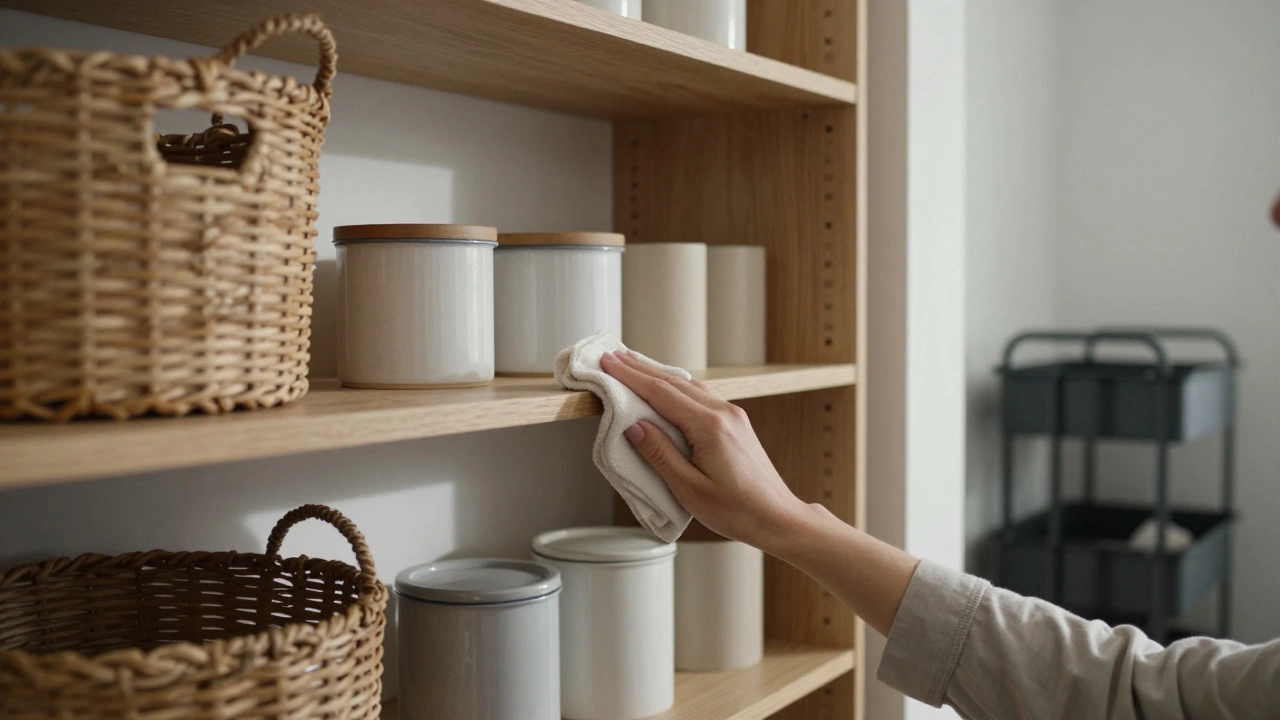
But here’s the catch: open shelving doesn’t eliminate storage needs-it just moves them. You still need somewhere to put your pots, pans, and pantry items. Without cabinets, you’re forced to display everything. That means you can’t hide clutter. And if your dishes aren’t perfectly clean or your mugs are chipped, your shelves look messy. That’s not just an eyesore-it’s a psychological cost. People who switch to open shelving often end up buying more storage bins, baskets, and decorative trays to make things look neat. Suddenly, you’re spending $200 on woven baskets and ceramic canisters just to hide what you thought you were showing off.
What you save (and what you don’t)
Open shelving saves money in three real ways:
- Material savings: No cabinet doors, no drawer boxes, no expensive finishes. Solid pine or reclaimed wood shelves cost less than half of a painted MDF cabinet.
- Installation savings: Mounting shelves takes a few hours with a level and drill. Installing cabinets requires precise framing, plumbing clearance, and often a professional. DIYers save $200-$500 in labor alone.
- Renovation flexibility: If you move or sell, shelves are easy to take down and reuse. Cabinets are permanent fixtures. That means your investment in open shelving has resale value.
But you lose money in three hidden ways:
- Time cost: Keeping open shelves looking tidy takes effort. Wiping dust, rearranging items, cleaning behind jars-this isn’t a one-time task. It’s weekly maintenance.
- Replacement cost: Glass or metal shelves can warp or rust over time. Wood can stain from grease or moisture. You’ll replace them sooner than cabinets, which last 20+ years.
- Opportunity cost: If your shelves look messy, you’re less likely to use your kitchen. That means you order takeout more often. A 2023 study from the University of Auckland found that people with cluttered open shelving ordered food 2.3 times more per week than those with closed cabinets.
Who benefits most from open shelving?
Open shelving isn’t for everyone. It works best for people who:
- Own a small kitchen and want to make it feel bigger
- Have a curated collection of dishes or cookware they’re proud to show off
- Don’t mind cleaning daily and keeping things organized
- Are renting and can’t install permanent cabinets
- Have a budget under $500 for storage upgrades
If you’re someone who hates dust, owns 12 sets of mismatched mugs, or keeps spices in unlabeled jars, open shelving will drive you crazy. You’ll spend more time organizing than cooking.

Real-world example: Auckland apartment renovation
In a 2024 renovation of a 65m² apartment in Ponsonby, the owner replaced two upper cabinets with three floating shelves made from recycled oak. The total cost: $180 for wood, $40 for brackets, $20 for tools. No labor. Savings: $1,100 compared to new cabinets.
But within three months, they bought:
- Three woven baskets ($75)
- Two ceramic canisters for flour and sugar ($60)
- A magnetic knife strip ($85)
- A small rolling cart for extra storage ($120)
Total added spending: $340. Net savings: $760. But they also spent 3-4 hours per week just tidying shelves. That’s 150+ hours a year. If you value your time at $20/hour, that’s $3,000 in lost time. Suddenly, the savings aren’t so clear.
Open shelving vs. closed cabinets: The real comparison
| Factor | Open Shelving | Closed Cabinets |
|---|---|---|
| Upfront cost (3 units) | $150-$300 | $900-$2,400 |
| Installation time | 2-4 hours | 8-16 hours |
| Monthly cleaning effort | High (daily wiping, rearranging) | Low (wipe once a week) |
| Storage capacity | Lower (items visible = limited stacking) | Higher (hidden space, deep storage) |
| Lifespan | 5-10 years (wood warps, metal rusts) | 20+ years (with proper care) |
| Resale value | Neutral or slightly negative (some buyers see as clutter) | Positive (expected feature in most homes) |
When open shelving is a bad idea
Don’t go open shelving if:
- You live in a dusty or humid climate (like Auckland’s coastal areas-salt and moisture ruin wood)
- You have kids or pets (they’ll knock things over or touch everything)
- You cook often and use greasy pots (oil stains become permanent on wood)
- You’re planning to sell your home in the next 2-3 years (closed cabinets are still the norm)
- You hate cleaning or have a busy schedule
One homeowner in Mount Eden replaced her cabinets with open shelves in 2023. Within six months, her shelves were covered in grease from daily frying. She spent $200 on a deep-cleaning service and $150 on a new set of shelves. She’s now back to cabinets.
Smart middle ground: Hybrid storage
You don’t have to choose all open or all closed. A smarter approach:
- Use open shelves for your most beautiful items: glassware, pottery, or cookbooks you love.
- Keep cabinets for everyday clutter: spices, cleaning supplies, extra plates.
- Install open shelves only above the sink or stove-areas where you don’t need deep storage.
- Use baskets or bins on open shelves to hide items you don’t want on display.
This gives you the look of open shelving without the maintenance nightmare. It’s called “strategic openness.” It’s what most interior designers in New Zealand recommend for small homes.
Final verdict: Does open shelving save money?
Yes-if you’re willing to accept the trade-offs. You save on materials and installation. But you pay in time, effort, and hidden purchases. If your goal is to spend less upfront and you’re okay with daily upkeep, open shelving is a smart choice. But if you want low-maintenance, long-term value, cabinets still win.
Think of open shelving like a car: it looks sleek, uses less fuel, and costs less to buy. But if you drive it every day in the rain, you’ll spend more on cleaning, repairs, and replacements. It’s not cheaper-it’s just different.
Is open shelving cheaper than cabinets?
Open shelving is cheaper upfront-often by $600-$2,000 for a kitchen. But you’ll likely spend more later on baskets, cleaning, and replacements. Total cost over five years is often similar.
Do open shelves make a kitchen look bigger?
Yes, if they’re kept tidy. Open shelves reduce visual weight, making ceilings feel higher and spaces feel lighter. But if they’re cluttered, they make a kitchen feel smaller and messier.
Can I install open shelves myself?
Absolutely. You only need a drill, level, and wall anchors. Most shelves take under 3 hours to install. Just make sure you’re attaching to studs or using heavy-duty anchors for weight.
Are open shelves good for small kitchens?
They can be, but only if you use them wisely. Limit open shelves to 1-2 walls and pair them with closed storage below. Avoid filling every shelf-leave breathing room.
Do open shelves collect more dust?
Yes. Every exposed surface collects dust, grease, and crumbs. You’ll need to wipe them at least once a week. In kitchens, daily wiping is common.
What’s the best material for open shelves?
Solid wood (like oak or pine) is best for durability and looks. Avoid particleboard-it warps with moisture. Metal shelves work in dry areas but can rust in humid kitchens. Glass is stylish but fragile and hard to clean.